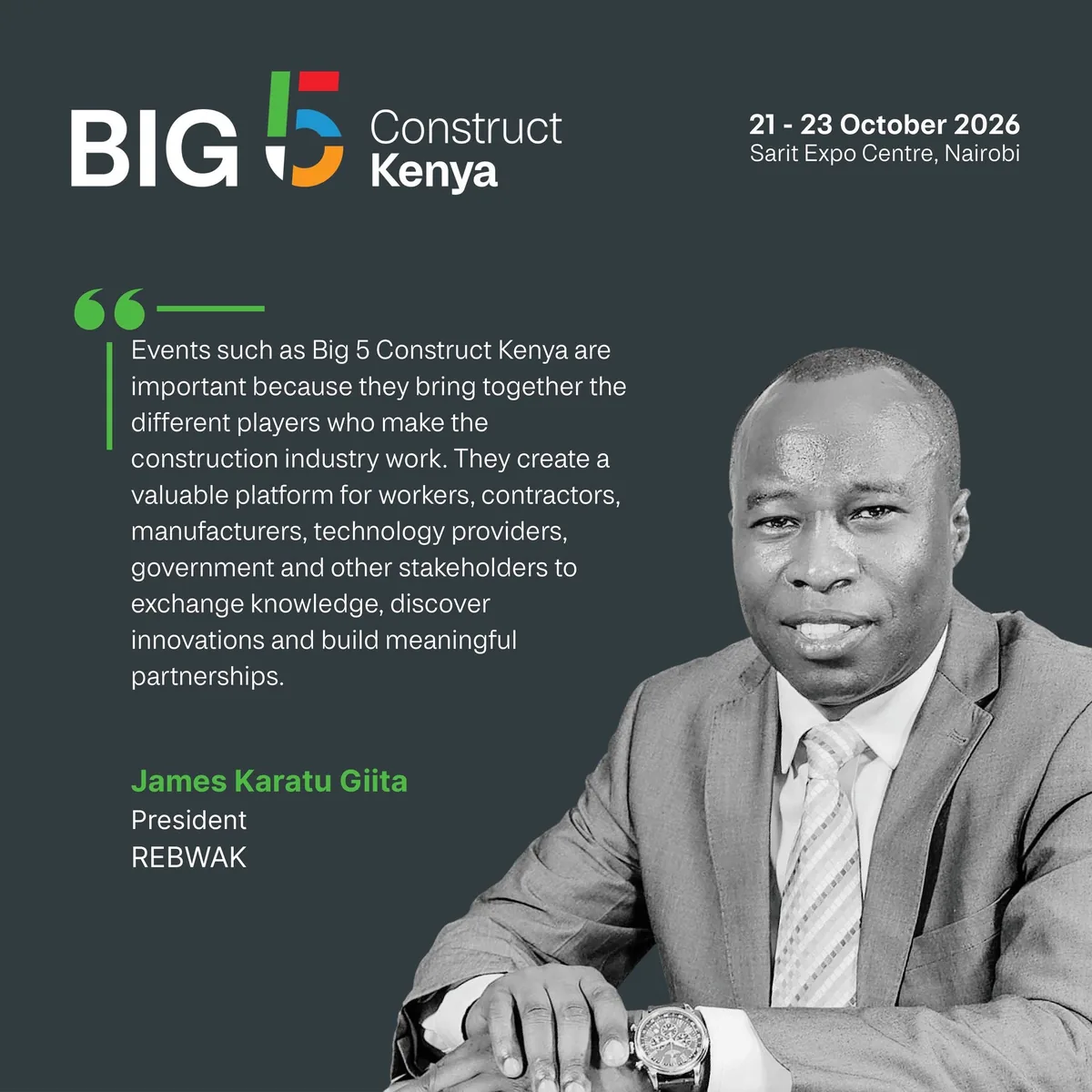
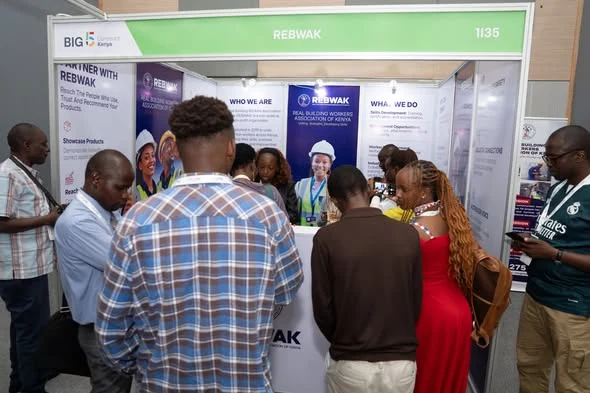
REBWAK used its stand at Big 5 Construct Kenya 2026 to push one message: construction site safety, WIBA insurance and first aid training build a stronger construction sector in Kenya. The show ran from 21 to 23 October at the Sarit Expo Centre, Nairobi, and REBWAK (Booth 1I35) took the Industry Talks stage with four sessions on safety, insurance and first aid, alongside a related talk on workforce skills.
The sessions were aimed at site managers, safety officers, foremen and supervisors, and CPD points were available to attendees who scanned their badges before each session.
What REBWAK presented at Big 5 Construct Kenya 2026
Construction site safety in Kenya: change the mindset first
Zakaria Kareri, General Treasurer, opened with the human cost: over 400 fatalities and over 10,000 worker injuries. He argued that safety starts with culture, replacing thoughts like “nothing has happened in years” or “PPE slows me down” with “no job is too small to be done safely.” Attendees also worked on writing short, catchy safety slogans, and the session closed on a simple policy: if it’s not safe, don’t do it.
WIBA insurance in Kenya: the statutory cover every contractor needs
Samson Ochieng, Secretary General, explained the Work Injury Benefits Act, 2007, which requires employers to insure employees against workplace injury, disease, disability and death. Cover applies to everyone on site, from casual labourers to engineers, and pays for medical care, rehabilitation, disability compensation and death benefits. He framed WIBA as both a legal duty and a way to protect cash flow and reputation, and stressed prevention: inductions, toolbox talks, PPE and equipment checks.
Personal accident insurance for construction workers: match the cover to the work
Samson Okoth, Secretary General and Risk Mitigation Advisor, covered voluntary accident cover that can pay for accidental death, permanent or temporary disablement and medical expenses. His advice was to declare each worker’s real duties, including work at height, excavation and hot work, and to read the exclusions, because not every activity is covered. He also gave a five-step claims routine: make safe, report, document, collect records and follow through. Treatment must never wait for paperwork, and this cover does not replace PPE, training or legal duties.

Construction site first aid for the “Fatal Four”
Julius Njiru, First Aid Trainer, walked site leaders through the four accident types behind most deaths: falls, struck-by objects, caught-in or between, and electrocution. He started from the basics (check danger, response, airway, breathing, circulation, call for help) and gave a protocol for each:
- Falls: assume a spinal injury for any fall over 1.8 m and keep the head still. A casualty rescued from a harness should sit semi-upright, not lie flat.
- Crush and trench collapse: call emergency services before freeing the casualty, as releasing a limb trapped for 15+ minutes can release dangerous toxins.
- Amputations: apply a tourniquet high and tight, and keep the severed part in a sealed bag on ice.
- Electrocution: isolate the power before touching the victim. If breathing is absent, use an AED and start CPR at 100 to 120 compressions a minute.
Construction skills for tomorrow’s workforce
The same theme ran through a related talk by Mark Gitau of Mac Mobile, “Building tomorrow’s workforce.” He argued that technical skill is still the foundation, but construction professionals now also need digital confidence (phones, BIM and project tools), professionalism and adaptability, with AI and drones as tools that help skilled people rather than replace them.
Why it matters for Kenya’s construction industry
REBWAK’s message was practical: cover every worker, train site leaders to respond in the first minutes after an accident, and build a culture where nobody works unsafely, even when no one is watching. As the WIBA session put it, “A safe workforce builds a stronger future.” REBWAK invited visitors to find the team at Booth 1I35.